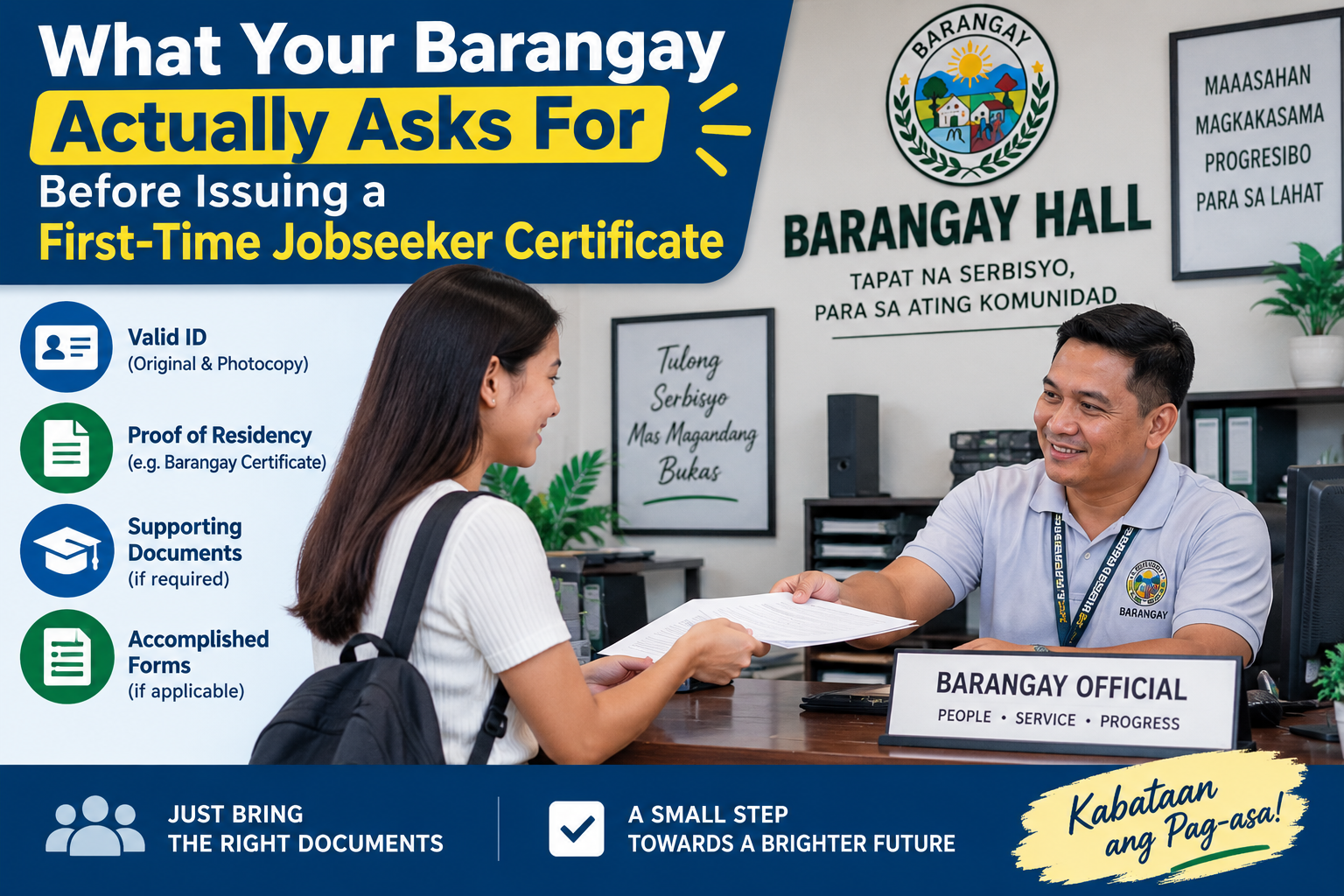
What Your Barangay Actually Asks For Before Issuing a First-Time Jobseeker Certificate
Barangay Certification for First-Time Jobseekers is a free paper your barangay issues under RA 11261. It confirms you’re a Filipino citizen, at least six months a resident, and looking for your first job and it unlocks free NBI, police, and other clearances for one year.
You don’t need to overthink this it’s quick, it’s free, and it’s usually done in one visit. What trips people up isn’t the barangay hall itself. It’s not knowing which document to ask for, or showing up without the right ID.
What “First-Time Job Seeker” Actually Means Under RA 11261
The law is specific about who counts. You need to be a Filipino citizen. You need to be actively looking for work, whether that’s a local job or one abroad. And you need to have lived in the barangay issuing your certificate for at least six months.
According to DOLE’s Cordillera regional office, a first-time jobseeker is a Filipino citizen who has never held a job before, is actively looking for work locally or overseas, and has lived in their barangay for at least six months — the barangay alone decides who meets that bar.
That last part matters more than people realize. The barangay isn’t just stamping paper. It’s making a judgment call about your eligibility, and different barangays interpret “never worked before” with different levels of strictness.
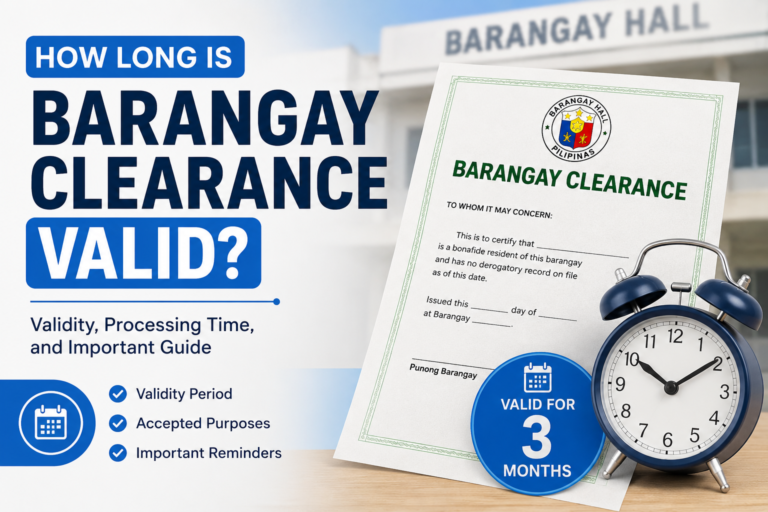
According to the University of the Philippines’ guidelines for implementing RA 11261, the barangay where you reside carries the primary responsibility for confirming your eligibility, and whatever certification it issues stays valid for exactly one year counted from its release date, not from when you first apply.
So if you graduated in March but don’t request the certificate until August, your one-year clock starts in August. Plan around that.
Barangay Clearance vs. Barangay Certification: Two Different Papers
A regular Barangay Clearance just confirms you live in the area and have no pending complaints employers ask for it as a standard requirement. A Barangay Certification for First-Time Jobseekers is different: it’s tied specifically to RA 11261, and it’s the only version that waives fees for your NBI, police, and other pre-employment clearances.
Republic Act 11261, signed in 2019, waives fees on documents like NBI clearance, police clearance, and PSA birth certificates for first-time jobseekers but only once. Some barangays still hand out a generic clearance instead of the specific RA 11261 certification, and that mix-up is where most applicants lose time.
Here’s the thing: if you ask for “barangay clearance” without mentioning RA 11261 or “first-time jobseeker,” you might walk out with the wrong document and pay full price for your NBI clearance anyway. Say the law’s name out loud when you’re at the counter.
| Option | Best For | Key Benefit | Limitation |
|---|---|---|---|
| Apply directly at your Barangay Hall | Getting the certification itself | Usually free, often released the same day | Only your barangay of residence can issue it |
| Visit your local PESO office | Fresh grads unsure which document to request next | Staff coordinate across agencies for you | Not every city or municipality has a fully staffed PESO |
| Use the NBI Clearance online portal’s First-Time Job Seeker option | Getting your free NBI clearance specifically | Skips the cashier line, fee shows as ₱0 | Still needs a valid government ID — the barangay cert alone won’t work |
What to Bring to the Barangay Hall
- Go to your barangay hall specifically the one where you’ve lived for six-plus months.
- Tell the desk you’re applying as a first-time jobseeker under RA 11261.
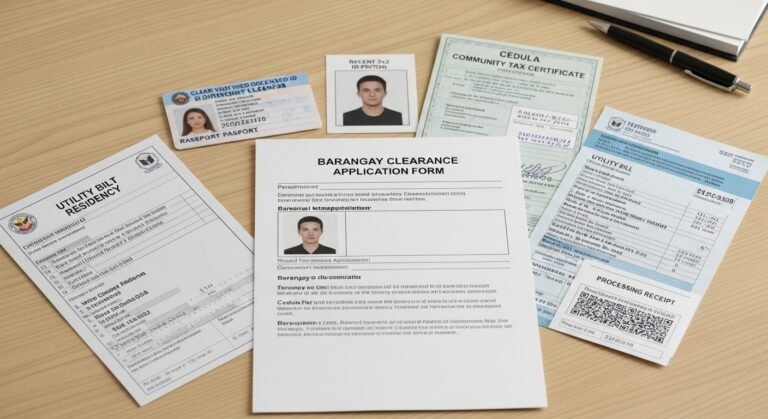
- Show one valid ID and any proof of residency.
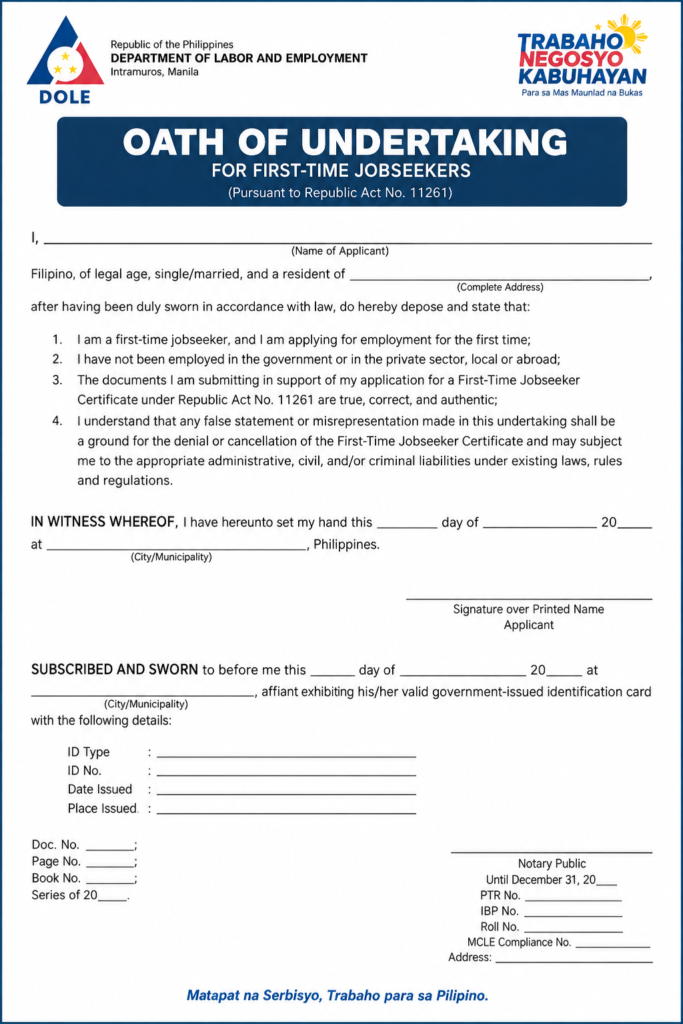
- Sign the Oath of Undertaking.
- Get your certificate most barangays release it the same day, free of charge.
Proof of identity
Any government-issued ID works. If you don’t have one yet, a school ID is usually accepted for recent graduates bring your diploma or a certificate of graduation as backup.
Proof of residency
This can be a barangay ID you already hold, a utility bill under a parent’s or your own name, or simply barangay records showing your address for the past six months. Ask the barangay secretary which they prefer; it varies by area.
The Oath of Undertaking
You’ll sign a short document declaring you’re a genuine first-time jobseeker, that you’ll use the benefit only once, and that you’ll inform the barangay once you’re employed. Falsifying this isn’t a minor slip it’s the one part of the process barangay staff take seriously.
What the Certificate Unlocks and How Long You Have to Use It
Once you have it, the certification can waive fees for: NBI clearance, police clearance, a regular barangay clearance, PSA birth certificate, CSC certificate of eligibility, PhilHealth ID, TIN registration at the BIR, UMID card through SSS or GSIS, transcript of records from state universities, and medical certificates from public health centers.
Most applicants assume the free NBI clearance is the main prize. It’s not or maybe I should say it this way: the barangay certification is the gatekeeper for every other clearance on that list, and skipping the birth certificate or TIN waiver leaves real savings on the table.
The certificate is valid for one year from its issue date, and it works only once one copy of each waived document, not unlimited requests. Losing the physical copy before you’ve finished using it means losing whatever benefits you hadn’t claimed yet; there’s no NBI-style reissue for this part.
Republic Act No. 11261, Official Gazette → proves the legal basis, coverage, and one-time fee waiver
Common Mistakes That Get First-Time Job Seekers Turned Away
Assuming any prior work doesn’t count
Some sources say only formal employment disqualifies you; others say any paid work, even informal gigs, counts against you. My honest read: it comes down to how strict your specific barangay wants to be, so ask directly instead of assuming you’re covered.
Losing the certificate mid-use
If you’ve already claimed your free NBI clearance but haven’t gotten your free PSA birth certificate yet, and you lose the physical certificate, you likely forfeit what’s left. Photocopy it the day you receive it.
Treating barangay staff as automatically familiar with RA 11261
Not every barangay processes these often. If staff seem unsure, a printed copy of the law’s key sections — available through the Official Gazette usually resolves it faster than arguing.
I’d argue the barangay certification matters more than the NBI clearance step people worry about most. Miss an NBI appointment and you just rebook it. Lose the barangay certificate before using it fully, and the entire one-time benefit is gone.
[INTERNAL LINK: Full List of Barangay Clearance Requirements (General) → “regular barangay clearance”]
Quick Answers to Common Questions
Is barangay clearance free for first-time job seekers?
Yes. Your barangay issues the RA 11261 certification for free, and that certification also waives fees for other clearances like NBI and police clearance but only once.
How long do I need to live in a barangay before I can get the certificate?
At least six months as a resident of that specific barangay. If you moved recently, request it from your previous barangay instead.
Can I use the certificate more than once?
No. The law allows only one copy of each waived document per person, so keep the original safe until you’ve used every clearance you need.
Do I need this if I already had a part-time job?
Probably not, since most barangays treat prior paid work even informal as disqualifying, though the final call rests with barangay officials.
What if my barangay refuses to issue the certificate?
Bring a printed copy of RA 11261, ask for the officer’s name, and if it’s still refused, escalate to your city or municipal PESO office.
Before You Go
This covers the general rule under RA 11261 small procedural differences exist between barangays, so treat this as preparation, not a legal guarantee. It’s built for genuine first-time applicants: fresh grads, K-12 completers, TESDA graduates, and anyone who has never held paid work before. If you’ve had prior employment of any kind, even informal, talk to your barangay directly before assuming you qualify.
DOLE-CAR official article on the First-Time Jobseekers Act → confirms the six-month residency rule and one-year validity