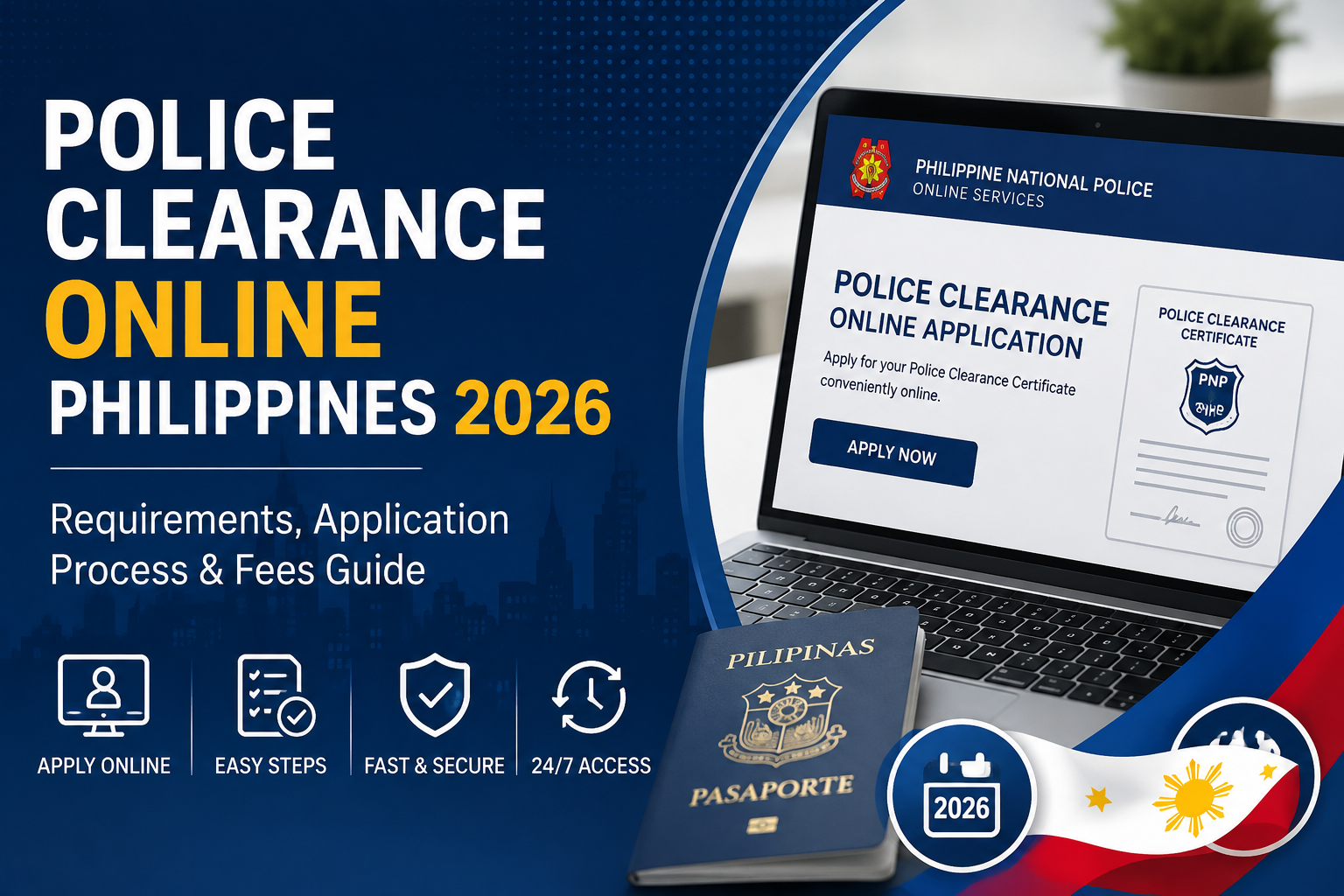
Police Clearance Online Philippines 2026
Requirements, Application, Fees, Appointment & Certificate Guide
A police clearance is one of the most requested government documents in the Philippines. Employers ask for it. Embassies ask for it. Banks, landlords, and licensing agencies ask for it too.
In simple terms, a police clearance is an official certificate from the Philippine National Police (PNP) that states whether you have a criminal or derogatory record on file. If your name comes back clean, your certificate will say “No Record on File.”
Getting one used to mean long queues, early wake-up calls, and a full day spent at a police station. That has changed. Through the National Police Clearance System (NPCS), you can now register, pick your police station, book an appointment, and pay your fee online before you even leave your house.
This guide walks you through everything you need to know about police clearance online in the Philippines for 2026:
- What police clearance is, and how it’s different from NBI clearance and barangay clearance
- The full list of requirements and accepted valid IDs
- A step-by-step online application walkthrough
- Appointment booking, rescheduling, and biometrics
- Current fees, processing time, and validity period
- How to check your application status
- Common problems and how to fix them
- Tips for faster approval, mistakes to avoid, and 30+ FAQs
By the end, you’ll know exactly what to prepare, what to expect at the police station, and how to avoid the delays that trip up most first-time applicants.
| Quick Answer: To get a police clearance online in the Philippines, register an account at the official NPCS portal, complete your profile, choose a police station, book an appointment, pay the ₱150 fee online, then visit the station on your appointment date for biometrics and photo capture. Most clearances are released within 15–30 minutes if there is no “HIT” on your record, and the certificate is valid for six months. |
What is Police Clearance?
A police clearance certificate is an official document issued by the Philippine National Police confirming whether a person has any pending criminal case or derogatory record in the PNP database.
Its main purpose is to serve as proof of good moral character and clean criminal history for:
- Local and overseas job applications
- Business permits and government licensing
- Firearm license applications
- Adoption, custody, or other legal proceedings
- Some travel and visa requirements (though NBI clearance is more commonly requested for this)
There are two versions of police clearance in the Philippines:
- Local Police Clearance (LPC): Covers records within a specific city or municipality only.
- National Police Clearance (NPC): Checks your name against the PNP’s centralized nationwide database. This is the version most employers and agencies now require, and it’s the one issued through the online NPCS portal.
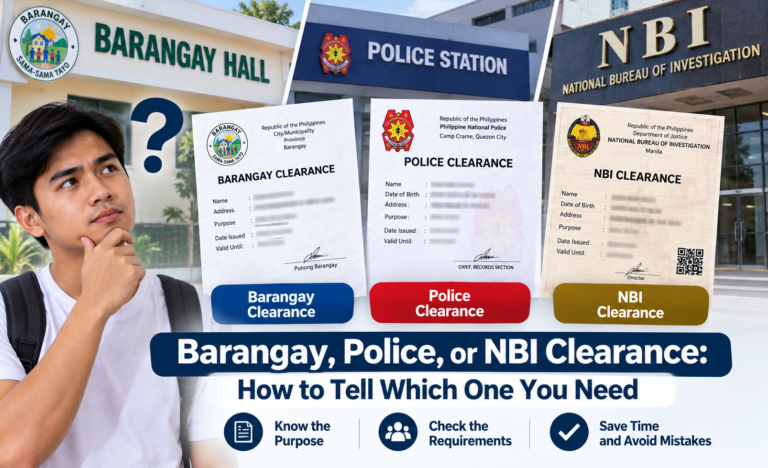
Police Clearance vs. NBI Clearance vs. Barangay Clearance
People often confuse these three documents because they all check a person’s background. Here’s how they differ.
| Feature | Police Clearance | NBI Clearance | Barangay Clearance |
| Issuing agency | Philippine National Police (PNP) | National Bureau of Investigation (NBI) | Barangay (local village/district office) |
| Database checked | PNP national/local police records | NBI national criminal database | Barangay records and resident conduct |
| Typical validity | 6 months | 1 year | 6 months to 1 year (varies by barangay) |
| Common use | Local employment, permits, gun license | Overseas employment, visa, passport-related requirements | Local transactions, business permits, residency proof |
| Where to apply | Any NPCS-participating police station | Any NBI Clearance Center | Your barangay hall |
| Online booking | Yes, via NPCS portal | Yes, via NBI Clearance online system | Rarely; usually walk-in |
In short: Police clearance and NBI clearance both check for a criminal record, but they pull from different databases and are issued by different agencies. Barangay clearance is a more local, community-level document and is not a substitute for either. Many employers ask for both an NBI clearance and a police clearance, so check the specific requirement of the office or company you’re applying to.
Police Clearance Requirements
Before you start your police clearance application, gather these requirements so your appointment goes smoothly.
| Requirement | Details |
| Two (2) valid government-issued IDs | Original, not expired; photocopies alone are not accepted |
| Active email address | Used for account verification and status updates |
| Active mobile number | For SMS notifications and OTP verification |
| Appointment confirmation | Generated after booking online |
| Proof of payment | Screenshot or printed receipt of your ₱150 fee payment |
| Barangay certificate (first-time job seekers only) | Required to avail of the fee waiver under RA 11261 |
| Marriage certificate (if applicable) | For married women using their married surname |
| Passport and ACR I-Card (foreign applicants) | Required in place of local government IDs |
A closer look at each requirement
Two valid IDs: You must present two original, unexpired IDs at the police station. One should ideally have your photo and signature.
Appointment: Walk-ins are discouraged and, in many stations, no longer accepted for National Police Clearance. Book your slot through the NPCS portal first.
Payment: You must complete payment before your scheduled appointment. Unpaid applications may be automatically cancelled.
Email and mobile number: These are used to verify your identity, send your reference number, and notify you of your clearance status, so use an email and number that you actively check.
Biometrics: On your appointment date, you’ll have your fingerprints scanned and photo taken at the police station. This step cannot be done online it requires your physical presence.
| Warning: Only use the official NPCS portal for registration and payment. Avoid third-party “fixer” websites or individuals who offer to process your clearance for an extra fee. These are not authorized by the PNP and put your personal information at risk. |
Accepted Valid IDs
The PNP accepts a wide range of government IDs for police clearance application. Bring at least two from the list below.
| Valid ID | Notes |
| Philippine Passport | Widely accepted, no additional ID usually required |
| PhilSys ID (National ID) | Accepted as a primary ID |
| Driver’s License (LTO) | Must be current and unexpired |
| UMID (Unified Multi-Purpose ID) | SSS, GSIS, PhilHealth, or Pag-IBIG variant |
| PRC ID | For licensed professionals |
| Postal ID (PostID) | Accepted if issued under current PHLPost standards |
| PhilHealth ID | Often required alongside a second ID |
| TIN ID (BIR) | Accepted at most stations |
| Senior Citizen ID | Issued by the local Office of Senior Citizens Affairs |
| PWD ID | Issued by the local government unit |
| Voter’s ID or COMELEC Voter’s Certification | Accepted where available |
| School ID with registration form (students) | Must be current school year |
| Company ID with Certificate of Employment | Accepted at some stations for employed applicants |
| OFW/OWWA ID | For overseas Filipino workers |
| Alien Certificate of Registration (ACR I-Card) | Required for foreign residents |
Tip: Requirements can vary slightly by police station, so it’s smart to check your chosen station’s specific ID list on the NPCS portal before your appointment.
Who Can Apply?
Police clearance is open to a broad range of applicants:
- Filipino citizens of legal age applying for employment, permits, or personal use
- First-time job seekers availing of the fee exemption under RA 11261
- Students who need clearance for school requirements or on-the-job training
- Employees renewing clearance for company requirements
- OFWs who need local clearance in addition to NBI clearance
- Foreign nationals residing in the Philippines, using their passport and ACR I-Card
There is generally no upper age limit, but applicants are typically expected to be at least 18 years old, since police clearance is tied to legal and employment transactions. Minors who need clearance for specific legal purposes should coordinate directly with their local police station.
Police Clearance Online Application
Here is the full step-by-step process for applying through the National Police Clearance System (NPCS).
Step 1: Register an Account
Go to the official NPCS portal and click Register. Enter your full legal name, birth date, email address, and a secure password. Double-check spelling your name here should match your valid IDs exactly.
Step 2: Verify Your Email
Check your inbox for a verification link or code from NPCS. Click it to activate your account. If it doesn’t arrive within a few minutes, check your spam or junk folder before requesting a resend.
Step 3: Login
Once verified, log in using your registered email and password.
Step 4: Complete Your Profile
Fill out your personal details: full name, address, contact number, civil status, and other required fields. Accuracy matters here — mismatched information is one of the top causes of delays.
Step 5: Choose Your Police Station
Select the police station where you want to complete your biometrics and pick up your clearance. Choose one that’s convenient for you, since you’ll need to appear there in person.
Step 6: Book Your Appointment
Pick an available date and time slot. Slots are limited per day, so book early especially if you need your clearance for an urgent employment deadline.
Step 7: Pay the Fee
Generate your payment reference number and pay through your preferred channel (GCash, PayMaya, over-the-counter, or online banking, depending on what your chosen station’s system supports). Keep proof of payment.
Step 8: Complete Biometrics
On your appointment date, go to the police station with your two valid IDs and proof of payment. Staff will capture your fingerprints, photo, and signature.
Step 9: Print or Download Your Certificate
If your name has no derogatory record, your clearance is typically released the same day, often within 15–30 minutes after verification. You can print it at the station or download the digital copy through your NPCS account.
| Tip: Bring a photocopy of your IDs even if not required — some stations ask for it as a backup, and it saves you a trip to a nearby printing shop. |
Police Clearance Appointment
Booking
Appointments are booked directly through your NPCS account after you select your preferred police station. Available slots depend on that station’s daily capacity, so popular stations in cities fill up fast, particularly on Mondays and near month-end.
Rescheduling
If you can no longer make your appointment, log into your account and look for the reschedule option before your scheduled date. Rescheduling too close to your appointment time may not be possible, so update it as early as you can.
Cancellation
You may cancel an appointment through your account. Note that cancellation does not automatically mean a refund — payment policies vary, so review the confirmation details you received after paying.
Missed Appointment
If you miss your appointment without rescheduling, your slot is generally forfeited and you may need to book a new one. Some stations allow a grace period on the same day; others require a completely new booking. Contact your chosen station directly if this happens to you.
Police Clearance Fees
Here’s what to expect in terms of cost.
| Fee Type | Amount |
| Base Police Clearance Fee | ₱150.00 |
| Online/System Convenience Fee | ₱10.00 – ₱30.00 (varies by payment channel) |
| Estimated Total | ₱160.00 – ₱180.00 |
First-Time Job Seeker Fee Waiver
Under Republic Act No. 11261, also known as the First Time Jobseekers Assistance Act, qualified first-time job seekers can get their police clearance for free, along with other documents like NBI clearance and barangay clearance.
To avail of this waiver:
- You must be a Filipino citizen actively seeking employment for the first time.
- You need a Barangay Certification confirming your first-time job seeker status, issued by your barangay of residence.
- The exemption is a one-time privilege once used, it cannot be claimed again within the same year for the same document.
Bring your barangay certificate to your appointment and inform the station staff that you’re applying under RA 11261 before you pay.
Police Clearance Processing Time
| Scenario | Typical Processing Time |
| Normal application, no record found | 15–30 minutes after biometrics |
| Application flagged with a “HIT” (possible name match) | Several days to a few weeks, pending manual verification |
| High applicant volume / peak season | Longer wait even without a HIT, due to station traffic |
A “HIT” simply means the system found another name in the database that’s similar to yours. It does not automatically mean you have a criminal record it often just means someone with the same or a similar name has an entry on file. The station will need to manually verify your identity against the flagged record before releasing your clearance.
Police Clearance Validity
A National Police Clearance is valid for six (6) months from the date it was issued. After that, it automatically expires and can no longer be used for official transactions.
Keep in mind:
- Some employers or agencies require a clearance that’s less than 1–3 months old, even if it technically hasn’t expired yet. Always check the specific requirement of the office requesting it.
- There is no “extension” process once expired, you need to apply again as if it were a new application, including a new appointment, payment, and biometrics.
- If you frequently need police clearance for job applications, it’s a good habit to check your expiry date and renew a few weeks ahead of time rather than waiting until the last minute.
Police Clearance Status Check
After booking and paying, you can track your application through your NPCS account dashboard. Common status labels include:
| Status | What It Means |
| Pending | Your application or payment is still being processed or awaiting your appointment date |
| Approved | Your record is clear and your certificate is ready for release or download |
| With HIT | The system found a possible match in the database; manual verification is needed |
| Cancelled | Your appointment or application was cancelled, either by you or due to a missed slot |
If your status has not updated for several days, especially if it shows “With HIT,” it’s best to follow up directly with the police station where you applied rather than waiting indefinitely.
Police Verification
Police verification is the in-person step of your application where your identity is physically confirmed against your online submission. It includes:
- Fingerprinting: A digital fingerprint scan taken at the station.
- Photo Capture: A current photo for your certificate and PNP records.
- Identity Verification: Staff compare your presented IDs with your NPCS profile to confirm you are who you say you are.
- Database Cross-Check: Your name and details are checked against the PNP’s national database for any matching derogatory record.
This step exists specifically to prevent identity fraud and to make sure clearance certificates aren’t issued to the wrong person or under a false identity.
Police Clearance Certificate
What It Contains
A typical police clearance certificate includes:
- Your full name, address, and photo
- Your signature
- A remark stating “No Record on File” (or details of any pending case, if applicable)
- The issuing police station and issuing officer
- The date of issuance and expiry date
- A unique control number and QR code for verification
How to Verify Authenticity
Many current certificates include a QR code or control number linked to the PNP database. Employers and agencies can scan the QR code or check the control number through the official verification page to confirm the certificate is genuine and still valid.
When It Is Accepted
Police clearance is generally accepted for:
- Local job applications
- Business permit applications
- Firearm licensing
- Adoption and legal proceedings
- Some visa and immigration requirements, though NBI clearance is more commonly required for travel abroad
| Warning: Never accept or use an altered, expired, or fake clearance certificate. Falsifying a government document is a criminal offense, and using a fraudulent clearance can lead to disqualification from a job or legal liability. |
Police Clearance for Employment
Different sectors have different expectations for this document.
| Purpose | Typical Requirement |
| Government jobs | Police clearance and NBI clearance are usually both required |
| Private companies | Often one or both, depending on company policy |
| Overseas employment / visa | NBI clearance is usually primary; police clearance may still be requested by the local recruitment agency |
| Business registration | Sometimes required alongside barangay clearance and Mayor’s permit |
| Professional licensing | PRC and other regulatory boards may ask for police clearance as a supporting document |
| Firearm license application | Required as a standard supporting document |
If you’re a first-time job seeker, remember to bring your barangay certification so you can claim the RA 11261 fee waiver during your application.
Police Clearance Near Me
To find a police station near you that processes National Police Clearance:
- Log in to your NPCS account and use the station selector when booking your appointment. Stations are typically listed by city, municipality, or district.
- Choose the station closest to your home or workplace to make your appointment more convenient.
- If a nearby station has no available slots, look at neighboring stations within the same city — since NPC checks a national database, your clearance is valid nationwide regardless of which station issues it.
Always book through the official NPCS appointment system rather than searching for third-party sites claiming to offer faster processing.
Common Problems and Solutions
| Problem | Solution |
| Website not loading | Try a different browser, clear your cache, or attempt again during off-peak hours (early morning or late evening) |
| Wrong name entered | Log in and edit your profile before your appointment; correct it in person with the station if already submitted |
| Payment shows as pending | Wait a few hours for the payment gateway to update; keep your receipt as proof in case you need to follow up |
| No appointment slots available | Check again the next day, as new slots open regularly; try a nearby station |
| Forgot password | Use the “Forgot Password” link on the login page and check your registered email |
| Application flagged “With HIT” | This usually requires manual verification at the station; bring extra ID and be ready to explain any name similarity |
| Duplicate account created | Contact the NPCS support line or your chosen station to have duplicate records merged or resolved |
| Certificate has a typo | Report it immediately at the issuing station for correction before you submit it anywhere |
Tips for Faster Approval
- Book your appointment as early as possible, especially during peak hiring season.
- Double-check that your name, birth date, and address match your valid IDs exactly.
- Use an email address and phone number you check daily.
- Complete payment right away instead of waiting until the last minute.
- Choose a police station with more available slots if your first choice is full.
- Arrive at least 15–20 minutes before your appointment time.
- Bring two original valid IDs, not photocopies.
- Keep both a digital and printed copy of your payment receipt.
- Wear appropriate attire for your photo capture no sunglasses or hats.
- If you’re a first-time job seeker, secure your barangay certificate before your appointment date.
- Avoid applying during lunch hours at the station, when staffing may be reduced.
- If your record shows a “HIT,” bring supporting documents like a birth certificate to speed up verification.
- Update your civil status and surname in advance if you’ve recently married.
- Save your reference and control numbers somewhere safe for status tracking.
- Apply for renewal a few weeks before your current clearance expires, not after.
Common Mistakes to Avoid
- Using a nickname instead of your full legal name during registration
- Registering with an email you rarely check
- Forgetting to verify your email before trying to log in
- Booking an appointment without completing payment first
- Bringing expired IDs to your appointment
- Bringing only one valid ID
- Assuming barangay clearance can substitute for police clearance
- Waiting until the deadline day to apply
- Ignoring the “With HIT” status instead of following up
- Using an unofficial or copycat website instead of the real NPCS portal
- Paying a “fixer” for faster processing
- Not saving your payment receipt
- Providing a mismatched address that differs from your ID
- Forgetting to bring your barangay certificate for the first-time job seeker exemption
- Not rescheduling early enough when plans change
- Assuming online registration alone completes the application without an in-person visit
- Misspelling your name during profile setup
- Not checking the specific ID requirements of your chosen station beforehand
- Submitting an expired clearance to an employer without checking the date
- Losing your control number, making status verification harder
- Applying at a station far from home without checking travel time
- Not bringing a face mask or following current station health protocols, if applicable
Key Takeaways
- Police clearance certifies you have no criminal record on file with the PNP.
- It’s different from NBI clearance and barangay clearance, though all three check a form of background record.
- Apply online through the NPCS portal: register, complete your profile, book an appointment, and pay.
- Bring two valid IDs and complete biometrics in person — this step cannot be skipped.
- The standard fee is around ₱150–₱180, but first-time job seekers can get it for free under RA 11261.
- Clearance is valid for six months from the date of issuance.
- A “HIT” status just means manual verification is needed, not automatic disqualification.
Pros and Cons of Applying Online
| Pros | Cons |
| No more long queues at the station | Still requires an in-person visit for biometrics |
| Choose your own appointment date and time | Slots can be limited during peak season |
| Pay conveniently through digital channels | System downtime can occasionally delay bookings |
| Track your application status anytime | Errors in your online profile can cause delays if not corrected |
| Reduces processing time on the actual appointment day | Requires stable internet access and a valid email/phone number |
Checklist
- ☐ Registered an NPCS account with correct personal details
- ☐ Verified email address
- ☐ Completed applicant profile
- ☐ Selected a convenient police station
- ☐ Booked and confirmed appointment
- ☐ Paid the clearance fee and saved the receipt
- ☐ Prepared two original valid IDs
- ☐ Prepared barangay certificate (if claiming first-time job seeker exemption)
- ☐ Arrived at the station on time for biometrics
- ☐ Verified certificate details before leaving the station
Timeline Infographic Content (Text Version)
Day 1 – Online Registration: Create your account, verify your email, and complete your profile.
Day 1 – Appointment Booking: Choose your police station and pick an available date/time slot.
Day 1 – Payment: Pay the ₱150 fee (or claim the RA 11261 waiver if eligible).
Appointment Day: Arrive early, present two valid IDs, complete biometrics and photo capture.
Same Day (Usually): Receive your certificate within 15–30 minutes if no HIT is found.
If Flagged With HIT: Wait for manual verification, which can take several days to weeks.
Within 6 Months: Use your clearance for employment, permits, or other legal transactions before it expires.
Frequently Asked Questions
1. How do I apply for police clearance online?
Register on the official NPCS portal, complete your profile, choose a police station, book an appointment, and pay the fee. You’ll then visit the station in person for biometrics.
2. Can I apply without an appointment?
Most stations now require an online appointment for National Police Clearance. Walk-ins may not be accepted, so it’s best to book ahead.
3. What IDs are accepted for police clearance?
Passport, PhilSys ID, driver’s license, UMID, PRC ID, postal ID, PhilHealth ID, TIN ID, senior citizen ID, PWD ID, voter’s ID, and similar government-issued IDs are generally accepted. Bring at least two.
4. How much does police clearance cost?
The standard fee is ₱150, plus a small online convenience fee, bringing the total to around ₱160–₱180 depending on your payment method.
5. How long is a police clearance valid?
Six months from the date of issuance.
6. Can foreigners apply for police clearance in the Philippines?
Yes. Foreign nationals can apply using their passport and Alien Certificate of Registration (ACR I-Card).
7. Is police clearance the same as NBI clearance?
No. Police clearance is issued by the PNP and checks police records, while NBI clearance is issued by the National Bureau of Investigation and checks a separate national database. Some transactions require both.
8. What if I have a “HIT” on my application?
A HIT means your name closely matches another record in the database. It requires manual verification at the station and does not automatically mean you have a criminal record.
9. Can I reschedule my appointment?
Yes, through your NPCS account, as long as you do it before your scheduled appointment date.
10. Can I get police clearance the same day?
In most cases, yes if there’s no HIT, your certificate is typically released within 15 to 30 minutes after biometrics.
11. Is police clearance required for first-time job seekers?
Yes, and first-time job seekers may get it for free under RA 11261 by presenting a barangay certification.
12. What happens if I miss my appointment?
Your slot is usually forfeited, and you’ll need to book a new appointment.
13. Can I use an expired ID for my appointment?
No. IDs must be valid and unexpired at the time of your appointment.
14. Do I need to bring photocopies of my IDs?
Original IDs are the main requirement, but bringing photocopies as backup is a good idea.
15. How do I check my police clearance status?
Log in to your NPCS account and check your application dashboard for status updates like Pending, Approved, or With HIT.
16. Can I apply for police clearance in a city where I don’t live?
Yes, since National Police Clearance checks a nationwide database, you can generally apply at any participating station, though local rules may vary.
17. What does “No Record on File” mean?
It means the PNP database found no criminal or derogatory record under your name.
18. Is online payment safe?
Yes, as long as you pay through the official NPCS portal and its listed payment partners, not through unofficial third-party sites.
19. Can married women use their maiden name on the clearance?
You can typically choose either your maiden or married name, but bring your marriage certificate if using your married surname for the first time.
20. Do students need police clearance?
Some schools require it for on-the-job training, scholarship applications, or specific academic requirements.
21. What if my name has a common HIT due to a similar name?
Bring additional identifying documents, such as a birth certificate, to help the station confirm your identity faster.
22. Can I download a digital copy of my clearance?
Many stations now offer a downloadable digital certificate with a QR code in addition to the printed copy.
23. Is there an age requirement to apply?
Applicants are generally expected to be of legal working age, though requirements can vary depending on the purpose of the clearance.
24. What should I do if the NPCS website is down?
Try again later, especially during off-peak hours, or check the official PNP social media channels for system status updates.
25. Can I use my police clearance for a visa application?
Some visa applications accept it as a supporting document, though NBI clearance is more commonly requested for travel and immigration purposes. Always confirm with the specific embassy or agency.
26. How do I correct an error on my printed certificate?
Report it immediately to the issuing police station before leaving, so they can correct it on the spot if possible.
27. What if I already have an old paper-based clearance?
Old clearances follow the same six-month validity rule. If expired, you’ll need to apply again through the online system.
28. Can I pay in cash?
Some stations allow over-the-counter payment at authorized payment centers, in addition to online payment channels.
29. Do I need to bring my own printer paper for the certificate?
No, the station typically prints your certificate. Some offer a digital copy you can print yourself later.
30. How many valid IDs do I need to bring?
Two, at minimum, both original and unexpired.
31. What is the difference between Local Police Clearance and National Police Clearance?
Local Police Clearance (LPC) only checks records within a specific city or municipality, while National Police Clearance (NPC) checks the PNP’s nationwide database.
32. Can I apply for police clearance if I have a pending case?
You can still apply, but your certificate will reflect the pending case rather than “No Record on File.” Consult a lawyer if you need guidance on how this affects your specific transaction.
33. How early should I renew my police clearance?
It’s best to renew a few weeks before your current certificate expires, especially if you’ll need it for a job application deadline.
34. Is a barangay certificate required for every applicant?
No, only for those claiming the first-time job seeker fee exemption under RA 11261.
35. Can I apply on behalf of someone else?
No. Police clearance requires the applicant’s personal appearance for biometrics and identity verification.
Conclusion
Getting a police clearance online in the Philippines doesn’t have to be stressful. Once you understand the requirements, prepare two valid IDs, and know what to expect at each step registration, appointment booking, payment, and biometrics — the whole process becomes straightforward.
To recap:
- Police clearance certifies your criminal record status through the PNP and is different from NBI and barangay clearance.
- Apply through the official NPCS portal, book your appointment, and pay the ₱150 fee (free for qualified first-time job seekers).
- Certificates are typically released the same day and are valid for six months.
- Avoid fixers, double-check your personal details, and always use the official government system.
Start preparing your documents today your valid IDs, your barangay certificate if applicable, and a few minutes to register your account so you can complete your police clearance application without delays. If you’re also applying for a barangay clearance or need guidance on other local government documents, explore our other guides on BarangayClearance.com for step-by-step help.